

Artificial intelligence (AI) is on the news, living in our social media apps, and a hot topic now debated in every major industry and field. Whether you are excited or concerned about the expansion of AI, FSU Libraries is here to support your curiosity.
The “AI in Popular Literature” Summer Reading List was curated by the Libraries’ Social Science Team, in collaboration with the Libraries’ Popular Literature (Pop Lit) Committee (you can learn more about Pop Lit on our LibGuide!), and includes bestselling nonfiction print and e-book titles that discuss artificial intelligence in all its forms. The titles span many different subject areas and topics too, including, but not limited to, education, philosophy, science, politics, environmentalism, and sociology.
Check out the reading list below and click on the embedded link for each title to find out more information on how to access!
Current Titles

Agentic Artificial Intelligence: Harnessing AI Agents to Reinvent Business, Work, and Life
by Pascal Bornet, et al.
Agentic Artificial Intelligence explores how AI systems that can act autonomously and pursue goals are poised to transform work, decision‑making, and organizations, while emphasizing the technical, ethical, and governance challenges of deploying increasingly self‑directed machines responsibly.

AI 2041: Ten Visions for Our Future
by Kai-Fu Lee and Chen Qiufan
AI 2041 uses a blend of imaginative short stories and expert analysis to explore how artificial intelligence could shape everyday life over the next two decades, highlighting both the profound benefits and the serious social, economic, and ethical risks that emerge as AI becomes deeply embedded in society.

AI Engineering: Building Applications with Foundation Models
by Chip Huyen
AI Engineering focuses on the practical discipline of designing, deploying, and maintaining real‑world AI systems, emphasizing engineering rigor, reliability, and lifecycle management over hype-driven experimentation.

AI Snake Oil: What Artificial Intelligence Can Do, What It Can’t, and How to Tell the Difference
by Arvind Narayanan and Sayash Kapoor
AI Snake Oil offers a sharp, evidence‑based critique of overhyped and misleading claims about artificial intelligence, showing how exaggerated promises and flawed deployments can cause real harm in areas like medicine, policing, and public policy while arguing for more honest, rigorous uses of AI.

Artificial Intelligence: A Guide for Thinking Humans
by Melanie Mitchell
Artificial Intelligence: A Guide for Thinking Humans by Melanie Mitchell offers an accessible, critical overview of modern AI that explains how today’s systems actually work, highlights their limitations and hype, and equips readers to think clearly and skeptically about AI’s real capabilities and future impact.

As If Human: Ethics and Artificial Intelligence
by Nigel Shadbolt and Roger Hampson
As If Human examines how artificial intelligence systems increasingly mimic human judgment and authority, arguing that treating machines “as if” they are human decision‑makers raises urgent ethical, social, and governance questions about responsibility, accountability, and trust in a world shaped by algorithmic power.

Brave New Words: How AI Will Revolutionize Education (and Why That’s a Good Thing)
by Salman Khan
Brave New Words explores how generative AI is transforming education, arguing that these technologies can expand access, personalize learning, and reshape teaching—if schools and societies thoughtfully adapt rather than resist the changes AI brings.

Co-Intelligence: Living and Working With AI
by Ethan Mollick
Co‑Intelligence argues that the real power of AI lies not in replacing humans but in learning how to think and work alongside intelligent tools, offering practical frameworks for using AI to enhance creativity, judgment, and problem‑solving across everyday and professional life.

Empire of AI: Dreams and Nightmares in Sam Altman’s OpenAI
by Karen Hao
Empire of AI by Karen Hao is a deeply reported, critical account of OpenAI’s rise that exposes how the race to dominate artificial intelligence has concentrated power, exploited labor and resources, and transformed a once‑idealistic mission into a new form of global techno‑empire.

Genesis: Artificial Intelligence, Hope, and The Human Spirit
by Henry Kissinger
Genesis reflects on the emergence of artificial intelligence as a transformative force in human history, arguing that society must thoughtfully reconcile accelerating technological power with enduring human values to preserve agency, meaning, and moral responsibility in the age of intelligent machines.

How to Think About AI: A Guide for the Perplexed
by Richard Susskind
How to Think About AI provides a clear, accessible framework for understanding what artificial intelligence can and cannot do, helping readers cut through hype to think critically about AI’s capabilities, limitations, and societal consequences.

Human Compatible: Artificial Intelligence and the Problem of Control
by Stuart Russell
Human Compatible argues that to ensure a beneficial future with artificial intelligence, researchers and society must redesign AI systems to remain aligned with human values and preferences, warning that poorly aligned super-intelligent machines pose profound risks to humanity.

I, Human: AI, Automation, and the Quest to Reclaim What Makes Us Unique
by Tomas Chamorro-Premuzic
I, Human argues that as artificial intelligence automates more technical tasks, the future of work and leadership will depend on cultivating distinctly human skills—such as emotional intelligence, ethics, creativity, and judgment—that machines cannot replicate.

More Than Words: How to Think About Writing in the Age of AI
by John Warner
More Than Words examines how modern AI language systems generate meaning beyond simple text prediction, arguing that understanding their social, ethical, and communicative impacts requires looking past fluency to questions of context, power, and human interpretation.

Nexus: A Brief History of Information Networks from the Stone Age to AI
by Yuval Noah Harari
Nexus traces the history of information networks from early human societies to artificial intelligence, arguing that humanity’s ability to build, trust, and govern shared systems of information has shaped power, cooperation, and conflict—and will determine whether AI strengthens or destabilizes the future of human civilization.

Prediction Machines: The Simple Economics of Artificial Intelligence
by Ajay Agrawal, Joshua Gans, and Avi Goldfarb
Prediction Machines explains how dramatic reductions in the cost of prediction through artificial intelligence are reshaping business and society, shifting value toward human judgment, data, and decision‑making rather than automating work outright.

The Coming Wave: AI, Power, and Our Future
by Mustafa Suleyman
The Coming Wave presents a stark, tightly argued warning that rapidly advancing AI and other transformative technologies are creating an unprecedented concentration of power, forcing societies to urgently confront how to contain these tools before they destabilize governments, economies, and global security.

The Singularity is Nearer: When We Merge with AI
by Ray Kurzweil
The Singularity Is Nearer updates Ray Kurzweil’s long‑standing thesis by arguing that accelerating advances in AI, biotechnology, and computing are bringing humanity closer to a technological singularity that could radically extend human capabilities, intelligence, and lifespan—while also raising profound societal and ethical questions.

The Age of AI: And Our Human Future
by Henry Kissinger, Eric Schmidt, and Daniel Huttenlocher
The Age of AI and Our Human Future argues that artificial intelligence represents a civilizational shift that will fundamentally reshape economics, security, and human identity, demanding new frameworks for governance, ethics, and international cooperation to ensure AI strengthens rather than undermines human agency.
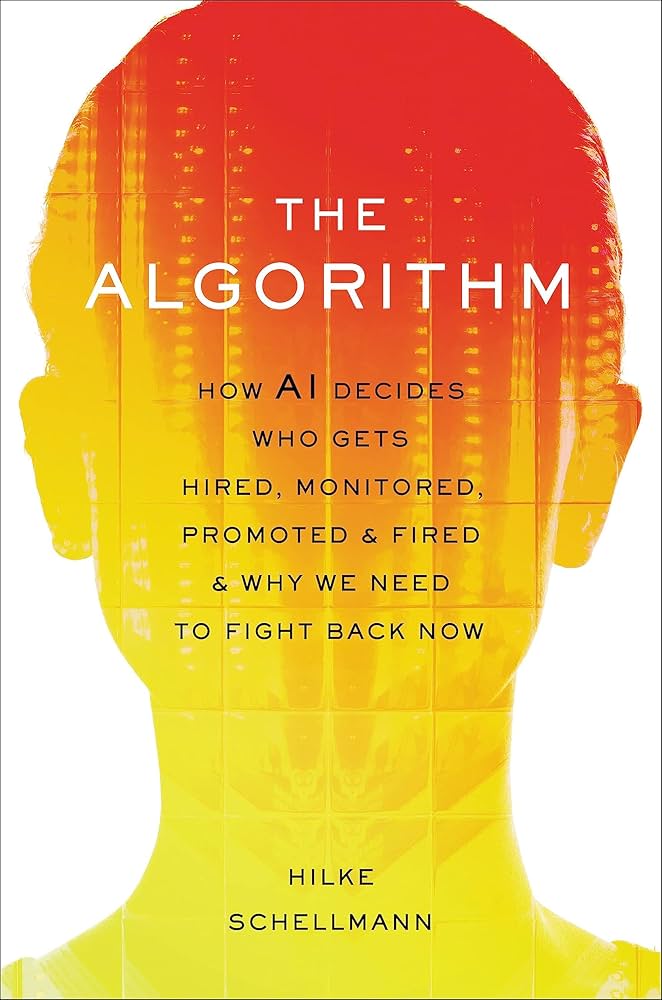
The Algorithm: How AI Decides Who Gets Hired, Monitored, Promoted & Fired & Why We Need to Fight Back Now
by Hilke Schellmann
The Algorithm investigates how algorithmic decision‑making systems increasingly shape hiring, surveillance, and workplace management, revealing how opaque AI tools can reproduce bias and inequality while calling for greater transparency, accountability, and human oversight.

The Alignment Problem: Machine Learning and Human Values
by Brian Christian
The Alignment Problem examines the real‑world consequences of misaligned AI systems, showing how biased data, flawed objectives, and human assumptions have already caused harm, and arguing that the challenge of aligning machine behavior with human values is a pressing social and technical problem—not a distant future risk.

The Thinking Machine: Jensen Huang, Nvidia, and The World’s Most Coveted Microchip
by Stephen Witt
The Thinking Machine traces the rise of artificial intelligence through the people, institutions, and ideas behind it, showing how technical breakthroughs and human ambition have combined to create systems that are reshaping power, work, and decision‑making across society.

Ways of Being: Animals, Plants, Machines: The Search for a Planetary Intelligence
by James Bridle
Ways of Being challenges human‑centered views of intelligence by exploring artificial, animal, and ecological forms of knowing, arguing that living responsibly in an AI‑shaped world requires humility, curiosity, and new ways of relating to nonhuman minds.

Why Machines Learn: The Elegant Math Behind Modern AI
by Anil Ananthaswamy
Why Machines Learn explains how modern machine learning systems came to dominate AI by tracing the mathematical, technical, and historical reasons behind their success, showing why scaling data and computation—rather than human‑like reasoning—has driven recent breakthroughs.
Upcoming Titles
The titles below will be available in the library collection sometime mid-July. Be sure to keep an eye out for these upcoming titles in the OneSearch library catalog if you are interested!

A Giant Leap: How AI is Transforming Healthcare and What That Means for Our Future
by Robert Watcher
A Giant Leap offers a clear, experience‑driven analysis of how artificial intelligence is reshaping healthcare, emphasizing both its transformative potential to improve patient care and safety and the cultural, ethical, and practical challenges clinicians and institutions must navigate to use AI responsibly.

Rewiring Democracy: How AI Will Transform Our Politics, Government, and Citizenship
by Bruce Schneier and Nathan E. Sanders
Rewiring Democracy argues that digital technologies and networked communication are fundamentally reshaping democratic systems, and contends that safeguarding democracy in the digital age requires rethinking governance, trust, and power structures to better align political institutions with how technology actually works.

The Next Renaissance: AI and the Expansion of Human Potential
by Zack Kass
The Next Renaissance presents an optimistic, accessible argument that advances in artificial intelligence will usher in a new era of innovation, abundance, and creativity by augmenting human capabilities rather than replacing them, fundamentally reshaping how people learn, work, and solve global challenges.
This post was written by Kirsten Bedford, Social Science Library Associate
Book summaries are courtesy of Microsoft Copilot (with human review)

Leave a Reply